
When to Hire an Attorney for Car Insurance Claims
Navigating an auto insurance policy after a crash can quickly become overwhelming, especially when an adjuster seems more focused on protecting their company’s bottom line than paying your legitimate expenses. Knowing when to step back and bring in a professional Motor Vehicle Accident Lawyer is crucial to protecting your financial future.
You should consider hiring an attorney for car insurance claims if:
- Your claim is unfairly denied or delayed: The insurer fails to give a valid explanation or drags out the investigation for months.
- You suffered severe injuries: High medical bills and long-term treatment require accurate valuation so you don’t run out of coverage.
- The adjuster gives you a lowball offer: The insurance company tries to settle quickly before the full extent of your injuries or vehicle damage is known.
- Liability is disputed: The other driver’s insurer refuses to accept fault despite evidence pointing in their direction.
- Multiple parties are involved: Multi-vehicle pileups often lead to finger-pointing among insurers, leaving victims caught in the middle.

Understanding First-Party vs. Third-Party Claims
Car insurance disputes generally fall into two categories: first-party claims and third-party claims. Knowing the difference changes how you handle the insurer and what legal rules apply. For a deeper breakdown of how these claims operate, read our detailed guide on Navigating Insurance Claims After Personal Injuries.
- First-Party Claims: This is a claim you file directly with your own insurance carrier. Examples include Personal Injury Protection (PIP) for immediate medical expenses, Collision coverage to repair your vehicle, or Uninsured/Underinsured Motorist (UM/UIM) coverage. Your insurer owes you a direct contractual duty under the written terms of your policy.
- Third-Party Claims: This is a claim you file against another driver’s insurance provider because their policyholder caused the accident. In third-party claims, the fault lies with the other driver, and their insurer protects their policyholder’s liability up to their policy limits.
In both scenarios, insurance representatives and defense teams often work to limit payouts, reduce liability, and protect the carrier’s financial interests. Having your own trial attorney helps balance the process by ensuring your claim is evaluated with evidence, legal strategy, and pressure for a fair resolution.
Common Reasons Insurers Deny or Delay Auto Claims
Insurers frequently use policy fine print and complex procedures to reject or stall valid claims. Some of the most common reasons adjusters cite include:
- Pre-Existing Condition Claims: Adjusters may argue your back, neck, or joint pain existed before the accident, ignoring how the crash aggravated your condition. (You can learn more about how symptoms develop over time in our article on Understanding Delayed Pain After a Car Accident).
- Policy Exclusions and Lapses: Insurers may claim an driver wasn’t listed on the policy, the vehicle was used for commercial ridesharing without an endorsement, or a payment was missed.
- Alleged Comparative Fault: The company may try to shift a portion of the blame onto you to reduce their payout proportionally.
- Delayed Filing or Notification: Failing to report an accident within the insurer’s strict window is often used as a reason for claim rejection.
- Automated Claim Denials: Modern carriers increasingly rely on computer algorithms to process claims, leading to wrongful automated rejections. To understand this trend better, see our analysis on The AI Revolution in Insurance Claim Denials.
Understanding Insurance Bad Faith and Denied Claims
Every insurance agreement contains an implied covenant of good faith and fair dealing. This legal standard mandates that insurance carriers cannot unreasonably withhold benefits or put their financial interests ahead of a policyholder’s legitimate rights.
When an insurer violates this duty, it crosses the line from a routine contract dispute into bad faith territory. Acts of bad faith include misrepresenting policy coverage, refusing to conduct a proper investigation, offering far less than a claim is worth without justification, or ignoring phone calls and emails.
How an Attorney for Car Insurance Claims Fights Bad Faith Denials
When an insurer treats you unfairly, an attorney for car insurance claims can take aggressive action through breach-of-contract lawsuits and bad faith litigation.
To prove bad faith, your lawyer must establish three core elements:
- You had a valid claim under the policy terms.
- Insurance benefits were withheld in whole or in part.
- The carrier’s reason for withholding benefits was unreasonable or lacked proper cause.
Our legal team counters insurer resistance by collecting detailed evidence, including accident reports, medical records, expert assessments, and internal insurer communications. We handle every step of the process while protecting your sensitive medical details—an approach outlined in our guide on How to Protect Your Personal Information During Litigation in New Jersey.
Essential Steps to Take If Your Claim Is Denied
If your insurance claim is hit with an unexpected denial or low settlement offer, taking the right steps early helps protect your case.
- Request a Written Denial Demand: Demand a formal letter from the adjuster citing the exact policy provisions, exclusions, or facts used to deny your claim.
- Organize Comprehensive Records: Gather all accident photographs, police reports, witness details, and medical bills. For practical guidance on initial documentation, review these Essential Actions to Take After a Car Accident.
- Avoid Giving Recorded Statements: Do not provide recorded interviews to the opposing insurance adjuster without legal guidance.
- Schedule a Strategy Consultation: Review the denial letter with an experienced lawyer to determine whether an internal appeal, mediation, or direct legal action is your best path forward.
Recoverable Damages and Contingency Fee Structures
When an insurance company wrongfully denies or underpays a claim, you may be entitled to recover compensation far beyond the original vehicle repair costs.
How an Attorney for Car Insurance Claims Calculates Your Damages
A skilled attorney thoroughly evaluates your economic and non-economic losses so no financial impact is overlooked. To learn more about how financial awards are classified, read our overview on Understanding 3 Types of Personal Injury Damages.
- Economic Damages: Concrete financial losses such as emergency room care, physical therapy, future medical treatment, lost wages, reduced earning capacity, vehicle repair expenses, and rental car costs.
- Non-Economic Damages: Intangible losses including physical pain and suffering, emotional distress, anxiety, loss of enjoyment of life, and permanent disability or disfigurement.
- Bad Faith & Punitive Damages: In egregious bad faith claims, courts may order the insurer to pay statutory penalties, interest, legal costs, and punitive damages to punish deliberate misconduct.
| Damage Category | Standard Car Insurance Claim | Bad Faith Insurance Claim |
|---|---|---|
| Vehicle Repairs & Property | Covered up to policy limits | Covered in full |
| Medical Expenses & Lost Income | Covered up to policy limits | Covered in full (including extra economic losses) |
| Pain & Suffering | Available in third-party injury claims | Recoverable for emotional distress caused by denial |
| Legal Fees & Court Costs | Generally paid out of settlement | Often awarded directly against the bad-faith insurer |
| Punitive Damages | Not available | Available for egregious or malicious insurer misconduct |
Fee Structures: How Contingency Fees Work
Many crash victims worry they cannot afford to hire a lawyer to take on a massive insurance corporation. At Eisbrouch & Marsh, LLC, we handle personal injury and insurance dispute cases on a contingency fee basis.
- Zero Upfront Costs: You pay nothing out-of-pocket to retain our law firm or start your case.
- We Pay Case Expenses: Our firm advances litigation expenses, court filing fees, expert witness reviews, and document collection.
- No Fee Unless We Win: We only collect a legal fee if we successfully secure a recovery through a settlement or trial verdict. Our fee is calculated as an agreed-upon percentage of your total financial award.
Choosing the Right Lawyer and Expected Dispute Timelines
Selecting the right legal team can make all the difference when going up against an insurer’s defense team.

How to Choose the Right Legal Representation
When searching for an attorney for car insurance claims, look for a firm with deep litigation experience, financial resources, and a strong track record.
- Look for Trial Experience: Insurance companies know which lawyers settle quickly for low amounts and which ones take cases to trial. Having dedicated litigators like Attorney David Eisbrouch, Attorney Eileen Marsh, and Attorney David J Panitz shows the insurer you are ready to fight for your claim in court.
- Review Proven Track Records: Evaluate a firm’s past case outcomes. Visit our Verdicts Settlements page to see how we have held insurance carriers accountable over our 30-year history.
- Demand Clear Communication: Choose a firm that provides direct, clear updates and answers your questions promptly. Learn more about our husband-and-wife attorney team on our About page.
Car Insurance Claim Dispute Timelines
Resolving an auto insurance claim dispute can take anywhere from a few months to over a year, depending on how stubborn the insurer is:
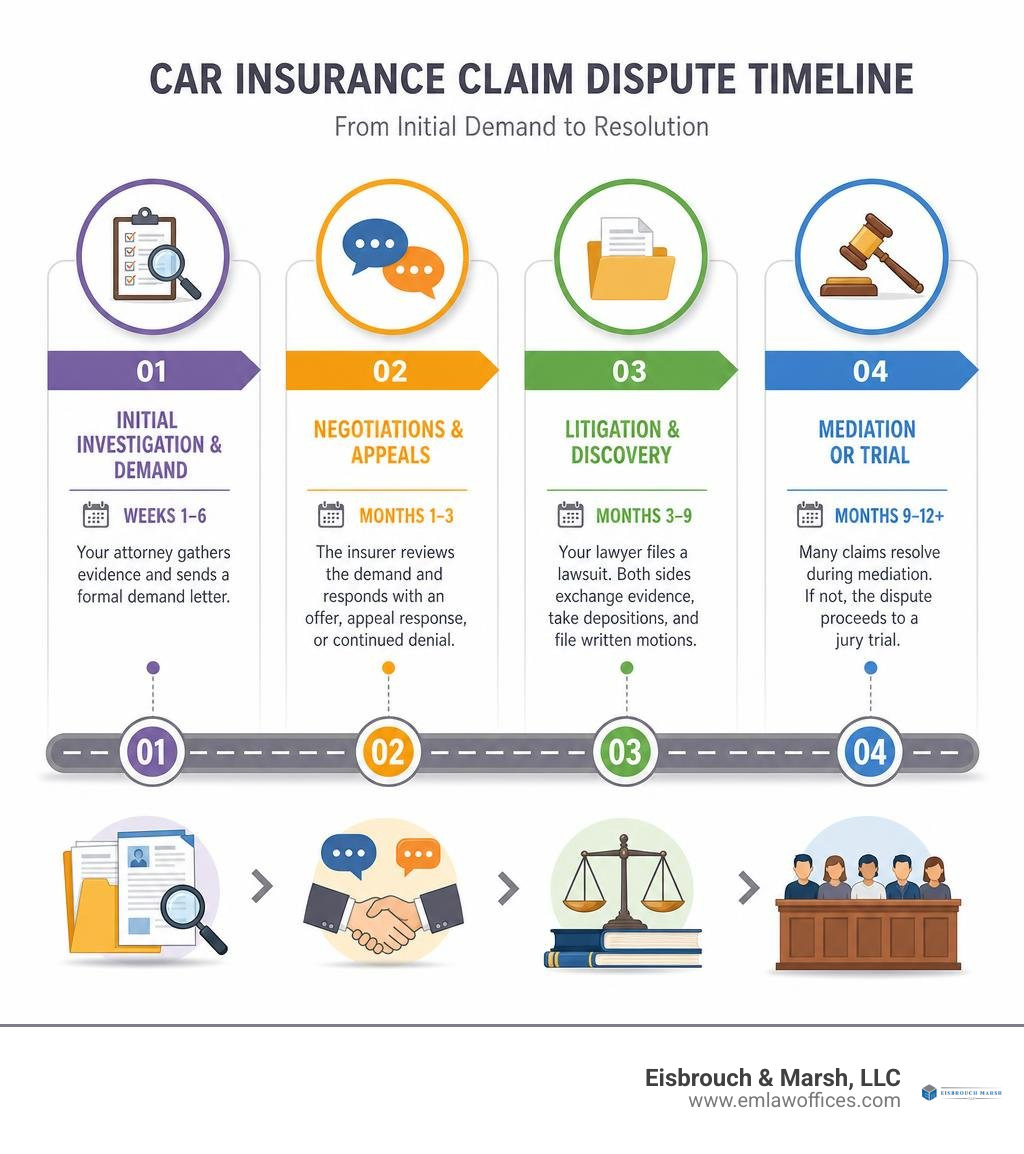
- Initial Investigation & Demand (Weeks 1–6): Your attorney gathers medical records, policy documents, and expert reports, then sends a formal demand letter.
- Negotiations & Appeals (Months 1–3): The insurance company reviews the demand package and either responds with an offer, an appeal response, or a continued denial.
- Litigation & Discovery (Months 3–9): If the carrier refuses to settle fairly, your lawyer files a lawsuit. Both sides exchange evidence, take depositions, and submit written motions.
- Mediation or Trial (Months 9–12+): Many claims resolve during court-ordered mediation. If an agreement cannot be reached, the dispute goes to a jury trial.
Frequently Asked Questions About Car Insurance Claim Disputes
How long does an insurer have to process a car insurance claim?
State insurance laws require carriers to acknowledge, investigate, and approve or deny claims within reasonable timeframes—typically within 15 to 30 days of receiving your proof of loss. If an insurer needs more time, they must send written updates explaining the cause of the delay. Unreasonable delays without proper explanation can be grounds for a bad faith action.
Can I sue my car insurance company if they underpay my claim?
Yes. If your insurance company fails to pay what your policy promises, you can file a breach-of-contract lawsuit. If the underpayment was deliberate or based on an unfair evaluation tactic, you may also have grounds for an insurance bad faith lawsuit to recover additional financial damages and legal fees.
What should I do if the accident involved an uninsured driver?
If an uninsured or hit-and-run driver causes your crash, you can file a claim under your own Uninsured Motorist (UM) coverage. Even though you are dealing with your own carrier, they may still dispute liability or downplay your injuries. For step-by-step guidance on handling these scenarios, read our advice on How to Handle a Crash With an Uninsured Driver.
Take Action on Your Car Insurance Claim Today
Insurance policyholders pay their premiums with the expectation that their insurer will step up when an accident occurs. When an insurance company denies, delays, or underpays your claim, you do not have to fight them alone.
At Eisbrouch & Marsh, LLC, our husband-and-wife partner team brings more than 30 years of legal experience fighting for injured drivers and policyholders across Hackensack and the surrounding areas. We know how insurance companies evaluate claims, and we use proven strategies to hold them accountable to their promises.
If you are dealing with a denied or underpaid auto claim, reach out to us today. Visit our Motor Vehicle Accidents page to explore your legal options, or Contact Us to schedule a free, no-obligation case evaluation. Let an experienced attorney for car insurance claims help you win your dispute and secure the full recovery you deserve.